2013-03-19

Not Afraid of Formalism


Hi friends,

I have a massive backlog of theory writings that I have been meaning to share on this blog, but I don't want to bore you, my dear readers, with theory babble. 

One thing that has come to my attention recently is the shift I have felt in my own design work.  I consider myself a contextualist, approaching architecture as a social science set within an ever-evolving milieu of physical culture-driven phenomenon.  While I like to explore design through whatever means most appropriately advances the concept I am pursuing, at Penn, I have dealt in more advanced techniques that before I would have considered outside my scope of knowledge-- not just in terms of project development (site analysis tools and conventions) but technologies. Software programs that I never thought I would dig into have actually been a balancing exercise for my usual manual-representation preferences.


Last year at the University of Cincinnati I took a course that taught Grasshopper and Rhino. While I listened to lectures that taught me how to use the program, I didn't really feel comfortable until I took it upon myself to become good at Grasshopper and play around until I felt comfortable. Nights spent exploring tools and outputs led to a greater sense of comfort with the program.  I applied the same approach to Arduino plugins, Sonic, Jellyfish plugins. You get the idea.  I still have plenty to learn, but now I feel comfortable taking on these more advanced softwares.  This was new for me.  I like to work in manual application-- through making models and sketching by hand.  Recently I have felt the same shift in appreciation toward my theory readings.  Sure, I always fancied myself a reader.. but not on the scale of XXX pages of reading per week? I am beginning to really enjoy this stuff.


Bringing this to a point: I think my obsession with acquiring new tools and proficiencies stems from a term that I read recently in a short (four page) article by Sanford Kwinter. Formalism.  Before reading the article I would have defined formalism as 

"a subjective act of craft, perception, or analysis resulting in an applied observation of an object in a given context." -me

Kwinter spins his definition of formalism a little differently:

"any method that diagrams the proliferation of fundamental resonances and demonstrates how these accumulate into figures of order and shape." -sk


I believe that my newfound appreciation for these tools is actually a result of my own resonance and appreciation for alternative representation.  I want to grow my skills to match the greatest capacity of the tools I am working with (digital for now).  In short, the environment at PennDesign has encouraged me to break my DAAP Revit-and-colored-pencil chains and try new things.  And since the tools at my disposal are parametric, system-centric, and meant to be largely iterative in nature, I have found myself gravitating toward these new technologies.


Kwinter reminds us that "Formalism derives from this historic emergence of themes applied in a specific location at a specific time" (see above). This is where I am. The tools and strategies I am learning are such because of where I am learning them and the current themes of teaching.

BUT the bigger question is... through this formalism-- this acceptance of certain tools and skills-- am I compromising my core design beliefs? Those that allow me to approach architecture as a social science set within an ever-evolving milieu of physical culture-driven phenomenon.  No, I don't think so.  But there is something inherently humanitarian (that is, society-serving) and grounded (that is, buildable, constrained by ease of realization) that I have always perceived in my work, and I think I am beginning to expand that horizon.


Find my reflections on a number of recent readings below:

SANFORD KWINTER 
WHO'S AFRAID OF FORMALISM
To define formalism "any method that diagrams the proliferation of fundamental resonances and demonstrates how these accumulate into figures of order and shape." Kwinter's strongest argument presents form as a resonance and expression of embedded forces. Kwinter argues that true formalism is a pure translation-- a genetic evolution even-- of an object's rules of formation applied in a given time and place.  To understand the form, we should always ask "why this object, institution, or configuration here, in this place, at this time, and not that?" Formalism derives from this historical emergence of themes applied in a specific location at a specific time.
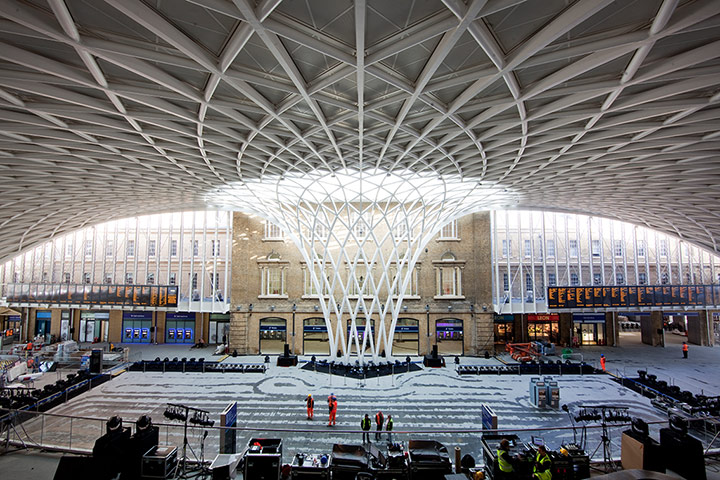
Which part of this building is contemporary?
All of it. Even the old part. Design is contemporary even if it has been built to look old,
for it represents a link to the style or form which it seeks to emulate.

ANTHONY VIDLER
THE THIRD TYPOLOGY
The "third type" of the city lends itself toward a closer consideration of architecture as a social vessel, each building contemporary to the time in which it was constructed.  Rossi's reflection to Victor Hugo's quote from the 1830's, that "communication through printed word...has released architecture from the roe of 'social book' into its specialized domain."  

Although architecture may no longer be a 'social book' it does frame the discussion of spatial organization in cities.  

Understanding that buildings cannot present a regular and unified face in this new urban typology, we must see cities as fabrics. As webs of integrated and conversant urban components-- infrastructure, landscape, and shelter-- that is, systems, fields, and objects interwoven to create a coherent and integrated urban 
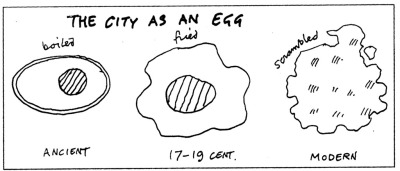
The urban form has changed over time.
Understand: URBAN itself is a typology for design

GREG LYNN
ANIMATE FORM
Greg Lynn presents the development of visual technology from the perspective that architecture has long been static and is moving toward a state of motion, flow, and arrangement whose mathematical foundations are not cartesian or polygonal, but rather U/V-mesh and spline-based.  This shift, he argues, takes architects from the topology-based model of 'stasis' to a model of 'shifting, shearing, rotation' and movement.  Lynn questions the form of architecture that lasts forever, instead arguing for design that is 'built for obsolescence, dismantling, ruination, recycling, and abandonment through time.' These traits are rarely considered at the outset of an architectural project, but merit consideration, especially from the standpoint of adaptive reuse (considering how spaces and systems will be replaced over time) and the immense strides made in technology (how long will it be before houses have USB connections instead of electrical outlets?).

Regardless, Lynn's main discussion revolves around his argument for a redefinition of space from being neutral and timeless to being temporally dynamic.  He explores how mathematics and 3D modeling programs allow for this process-- for designers can now apply advanced mathematical properties to their digital creations without ever needing to know the geometries and calculus that under-girds their explorations.

Architecture may break from its tradition of stasis
and embrace a position of cultural dynamism

2013-02-23

ARCH 502: Preliminary Manifesto

A preliminary manifesto generated for ARCH 502+522 Urban Design studio.  Taking some cues from Stan Allen, Sanford Kwinter, and the Patron Saint of Architecture. Comments welcome and appreciated!


2013-01-08

PennDesign Review Fall '012

Greetings Arch-Perspectivo's

It's high time I wrote about something with an architectural twist.. how about a reflection on this past semester -- a top ten if you will (plus one) -- of studying Architecture at the University of Pennsylvania.

10+1 - the Making Space Symposium at the beginning of the semester. If ever I saw a design exposition that received nowhere near as many accolades as it deserved, this was it.


10 - Giant Nyan-Cats


9 - Making a model of the Barnes Foundation. It's a beautiful building and making a 3/16" = 1'-0" scale section model made me appreciate TWBTA's intricacies all the more.


8 - Food Trucks. That is all. Salt and Pepper, I'm looking at you.
7 - Tiny glue bottles from PLAZA (actually, from back when it was Lance's). DAAPers know what's up. Some marketing genius decided that slapping a mechanical pencil top onto a plastic eye-dropper bottle could be sold for 5 bucks to arts students. And boy, were they right! Model-makers know that tiny glue bottles are the best way to model anything with SOBO.


6 - ASUS laptops. They're pretty great -- way better, in fact, than I first gave them credit for (although carrying around an ASUS 17-inch is comparable to giving a toddler a sempeternal piggy-back ride (although probably with less screaming and puking involved).

grasshopper sold separately, batteries not included


5 - the Hammitt Hammock in Simon's Studio


4 - "Annyong" and all its many spin-offs. 안녕하세요! including this beauti-doodle of Dr. Dave:


3 - PennDesign Super Happy Hour. I never would have guessed that the Lower Gallery could be transformed into a space somewhere between National Mechanics and an Alpha Rho Chi Rabirius dance party.
2 - Ivory soap

identity obscured to protect the uninitiated

And the number one best thing about studying architecture at the University of Pennsylvania...
1 - Squirrel Cannons


So this comes just as a new semester is about to begin. Who knows what the next few months will bring? Hopefully more Ivory Soap.

2012-10-15

PennDesign Theory 1.2 - Type

When Carl Linnaeus set forth in the 1750’s to classify all living life into kingdoms, phylums, classes, orders, families, genuses, and species he was setting a scientific precedent for the future of all zoology, botany, and biological sciences.  Boldly taking on the task- God’s first biblical task to mankind- that of naming all living life on Earth, Linnaeus nevertheless proceded undaunted, taking his best guess at the development of species and their relative relationship to one another.  Prior to Linnaeus, the study of nature was left to an elite class of educated gentry whose naming system and theories on biological classification differed as widely as the animal kingdom itself. Linnaeus’s classifications may have been naive (and perhaps even nostalgic), but they have lasted 250 years, with refinements along the way, to help us navigate the web of life with a common language and reference system-- allowing for a more refined and specific dialogue of inquiry, development, and discovery.

Carl Linnaeus and the relationality of types

Texts by Moneo, Vidler, and Corbusier delve into the concept of type and what it means to practice an art of subjectivity, customization, and delight in an age of scientific  enumeration.
Vidler walks the reader down a path of archaeological and anthropological discovery, beginning with an analysis of the earliest works of architecture- the pre-renaissance Temple of Solomon and other rustic houses of worship- contrasting their god-given proportions with those derived from piecemeal, organic development - namely Laugier’s primitive hut, constructed from the basest materials - the earth (foundation), trees (vertical structure), and branches (horizontal protection from the elements).  Vidler then addresses the term type, attaching the word in its earliest form to the works of Ribard de Chamoust, who defined type in regard to architecture as “the first attempts of man to master nature, render its propitious to his needs, suitable to his uses, and favorable to his pleasures,” (Vidler, 98) different from Chamoust’s concept of archetypes - those being the “fundamental elements of architecture” (99) - such as trees (vertical elements of the Primitive Hut’s architecture) which are merely types.  Pursuant of a better definition for type, Vidler takes the word back to its original Greek roots, where it meant “impression” or “figure” from the verb “to beat.”  Breaking from the theological inclinations of type, Vidler traces the development of type through the works of Blondel, Boulee, Ledoux, Durand, Pugin, and eventually to Qatremere who made the most scientific classification of type - “relative” type, he argues is non-classifiable, “as opposed to essential [type], in the uses to which it is intended” (Vidler, 105).  Perhaps taking a cue from the scientific enumeration that brought Carl Linnaeus to his scientific naming system 70 years prior, Qatremere states, “classification, as a fundamental and constituent problem of natural history, took up its position historically, and in a necessary fashion, between a theory of the mark and a theory of the organism.” (Vidler, 105). In this vein of historical progress, type becomes increasingly more scientific, and from Qatremere onward the style of classicism is seen as only one of many possible styles for architecture- its types are seen as a limited typology that grows as other styles are discovered, but all of whose archetypes remain those first and most foundational elements of construction - the earth (foundation), trees (vertical structure), and branches (horizontal protection from the elements).

The evolution of the ideal type:
from Paestum to the Parthenon, from the Humber to the Delage.
Le Corbusier, 1923

Le Corbusier takes a far more specific prose on type, organizing his thoughts on “man, a constant, the fixed point that in truth is the only object of our concern (Le Corbusier, Type Needs Type Furniture, pg 3). He stresses the need to see objects - indeed all objects - in relation to the human body, maintaining, “we must therefore always seek to rediscover the human scale, the human function” (p 3).  Though he stops short of defaming non-human-scale objects as objects unworthy of typology and use, he maintains the sacred nature of the human-scaled object.

Cold and brutal = right and true?

Moneo takes the reader on a pleasant stroll down architecture-typology-lane qualifying the developments of architecture to be seen best as “objects in their own right - as with paintings, but having elements made to evolve” (Moneo, 1).  Seen in this light, as well as the light of Durand’s infinite variation (a method of composition based on a generic geometry of axis superimposed on the grid) “the connection between type and form disappears” (29) as infinite variety merges with infinite variety - evolution within evolution - type stands in humble acquiescence, aware that dichotomy and categorization are futile devices in the face of myriad variety and customization.”


When nature is in control, the classification process yields a reading of life - to analyze the objective and genetic bifurcations of plants and animals alike.  When humans - and artfully inclined humans at that - are in control, the classification of various types and forms becomes nearly impossible - to analyze the subjective choices of stylistically-inclined individuals in the context of innumerable typologies, classification simply breaks down and yields to broad categorization of architectural tropes -  classicism, modernism, post-modernism, and the like - or a narrow analysis of objects within architecturally defined spaces - tables, chairs, windows, doors, etc.  In summary, I think that Moneo captures the immense task and opportunity that an architect faces when challenged to design a building in light of four millennia of architectural thought and creation: “the design process is a way of bringing the elements of a typology - the idea of a formal structure - into the precise state that characterizes the single work.” (Moneo, 3).

Works Cited:
Vidler, Anthony. The Idea of Type: The Transformation of the Academic Ideal. pp. 95-115