2014-01-13

Contextualizing the Ineffable


Contextualizing the Ineffable

In 1982 two theoreticians engaged in a debate that would prove pivotal to the formation of contemporary architectural theory.  These men – Christopher Alexander and Peter Eisenman – met for a brief battle of wits, pitching their architectural practices and unique theories against each other.  At first glance most would see their interaction as a battle of egos; each had a unique approach to design that contrasted with the accepted approach of Modern architecture.  So who won?

Even now, three decades since their fateful clash, the impact of the 1982 debate and the consequential shifts it imposed on the architectural profession still rest largely unresolved.  Contemporary architectural theory has not elected which of the two men (if either) was worthy to impress their propositions as the only (or best) way of designing.  Their built works and published theories illustrate that Eisenman and Alexander both stand exemplary for committed design philosophies and realization of their ideas into constructed projects.  Simply put, contemporary design and pedagogical structure has not embraced either theorist’s polemical proposals completely.  Nuances in contemporary theory predate and post-date the 1982 lecture, and therefore their debate proves a useful watershed moment (and lens) with which to view previous theory and also to project the future of architectural scholarship and practice.

To more easily understand the consequences of their debate, this paper summarizes the terms of Eisenman and Alexander’s 1982 interaction and, given the path architecture has taken since then, suggests ways in which both participants have been proven correct or incorrect.  The strengths and weaknesses of each will be taken into account, as well as points that they share in common. Two post-World War II case studies (Rafael Moneo’s Logrono City Hall and Peter Zumthor’s Steilneset Witch Memorial) will also be considered for how they subscribe to or dissolve the respective theories of Alexander and Eisenman.

For this first section (Summary) in keeping with the polarizing nature of this topic the paper has been structured to heighten and visually illustrate points of connection (or, more often, dissonance) between the two competing points of view.  Purple bars underscore potentially shared views and theoretical conceits. Blue bars mark Alexander’s thoughts.  Red bars mark Eisenman’s thoughts.  “Contemporary” always refers to 1982 unless explicitly stated otherwise.

All text ‘in quotes’ has been extracted from 1982 lecture.

Back to the Present


These summaries should be contrasted with each speaker’s views of actual built projects.  As only one of the buildings enumerated in their lecture was built in the post-World War II era (Palazzo Chiericati and Chartres Cathedral are significantly earlier) Let us consider two buildings for comparison: Logrono Town Hall by Rafael Moneo and the Steilneset Memorial by Peter Zumthor.


Case Study I
Rafael Moneo’s Logrono Town Hall


Rafael Moneo is famous for a modified mode of late modernism.  Toeing the line of post-modern, Moneo consistently employs building elements and facades that reference out-of-scale classical themes.  His Town Hall at Logrono was cited in the 1982 lecture by Peter Eisenman to call attention to the too-skinny columns of its southern courtyard (appendix: figure 1).  These too-thin columns are balanced at the opposite end of the courtyard with a series of columns that are too thick.  But is this balance or imbalance?  And is one better than the other?  The building is undeniably architectural.  Eisenman acknowledges that the town hall building steps back from the urban fabric (appendix figure 2), and this distance not only causes the building to fold in in itself, but its column and courtyard scaling causes even the most uneducated Spaniard to ask why? Why this shape? Why this scale? And in this question, Moneo asserts that a building with right-sized (comfortable) units does not cause its users to pause and consider their place in inhabiting the building.  Out-of scale elements cause us to question our interaction with the built environment.
Alexander would disagree with this scaling of elements, but he would not disagree with the cosmology it seeks to promote.  Our anthropocentric view of the world is comfortable in the Logrono Town Hall.  By acknowledging a poche and a void – an other space and a public space, the building seems to beckon its users to consider the unspoken tie between self and others.  And although the effects of this milieu may be lost on Eisenman, it would not be lost on Alexander or the inhabitants of Logrono who have lived with the presence of an others/self past for over 400 years.  Logrono, of course, was the main seat of the Basque witch trials in the early 16th century.  This heritage is bound to the people of this place, and carries an unspoken presence of exclusion – and possibly fear – into even newly-constructed buildings.  This preclusion to an others/self worldview is echoed in Richard Sennett’s most recent publication Together in which he compares living in a culture of inclusion/exclusion to the philosophical question of Montaigne’s Cat: in this example, Montaigne famously asks, ‘when I am playing with my cat, how do I know that she is not playing with me’.  Interpreted by Sennett (Sennett Together, 2012), this others/self dichotomy is indicative of an awareness that we all innately have for the phenomenological interaction of space/self.  When we inhabit a building, as I am sure both Alexander and Eisenman would agree, how do we know it is not the building inhabiting us?


Case Study II
Peter Zumthor’s Steilneset Memorial


One building that astutely addresses the harmony and discord of social interaction is the Steilneset Memorial by Peter Zumthor.  Completed in 2011, this memorial is composed of two buildings— one, a triangular pavilion of wood, commemorates the 91 lives lost in Norway’s Vardo witch trials of 1662-1663, another, a cube of glass and steel, provides an introspective and build-form awareness for the role we all play in accusation and interaction with those beyond our boundary of comfort.  
While the buildings physically occupy a pier of stone in the Norwegian hinterlands, they also semantically stands alone as two of the very few buildings whose entire purpose is to memorialize the lives lost to ideological hatred.  To Alexander, this awareness for time and memorial resonates with his beliefs that buildings built in basic form (appendix: figure 3) connect with our primitive perception of meaning in architecture.  The triangular structure looks like a traditional roof gable, representative of Spartan Nordic homes of the time period.  The cube structure carries a greater Heideggerian trope addressing the ‘question of being’ (Beckman Heidegger and Environmental Ethics, 2000).  By situating these two buildings in opposition with one another, it is easy to see their respective impact on their inhabitants.  The buildings’ simple platonic forms resonate so deeply with us because they are unencumbered with systems and methods of formation.  They simply exist to provide the most ‘perfect physical, emotional, and practical’ representation of the witch trials.  In his Timeless Way of Building Alexander asserts that ‘the very methods we invent to free us from our fears… are themselves the chains whose grip on us creates our difficulties’ (Alexander the Timeless Way, 1979).  Certainly the Steilneset Monument is beset by a system of methods appropriate for a memorial, but the way in which the elements of both buildings are structured brings out the depth of their purpose and still conveys, in simple terms, the readability of their intent. 
In one of his soliloquys at the 1982 lecture, Eisenman maintains that ‘disharmony might be part of the cosmology we exist in’, and that architecture should ‘find a way to deal with that anxiety’.  He would undoubtedly find solace in the way with which Zumthor addresses the world’s disharmony and anxiety by maintaining an ordering of elements that is a cosmological inversion of our expectations for a memorial.  Steilneset may be one of the few buildings that Alexander and Eisenman would agree pushes modern architecture toward an idealized, ineffable reality.  The memorial harmonizes space with an impeccable exactitude while still leaving room for interpretation and allowing visitors to experience the disharmony of a void— questioning why it was done and how it allows us to question the anthropocentric reality of others/self cosmology.


Reflections on Summaries


Christopher Alexander had his hands full openly debating Peter Eisenman.  Although no sources divulge what the audience or speakers were given as a prompt prior to the debate other than the title “Constrasting Concepts of Harmony in Architecture”, both participants knew each other very well (both studied at the AA) and both no doubt were aware that their respective interests would converge on the merits, nature, and origin of order, form, and harmony in architectural theory.  Considering the gravitas of this discussion, both speakers admirably held their own and were able to make valid, if contestable, claims on their particular ideologies.
Given the prior five-point summary, it now falls to discuss which of the two speakers was most successful in their arguments.  Also, given development in the thirty-one years since their debate, which speaker has triumphed in the long run?  Eisenman, described by Reyner Banham as “a self-annotating solipsist”, is infamous for providing casual comments on the normalcy of life ‘I always get nervous in a situation like this’, etc. , and then striking quickly to make a point that proves his supremacy in a given argument (pick any of the sentences you have to read three times to fully understand).  Alexander on the other hand employs a more Socratic approach – when asked about French Structuralists, ‘What do they say?’— dissolving a problem piecemeal and providing systematic insight (plus his own opinions) against those of his opponent.  Taken objectively, Eisenman made claims that were both bold and self-reinforcing.  He begins and ends his debate dialogue by referencing specialists in the field (French Structuralists, as well as architect Rafael Moneo) which throw Alexander for a loop.  Alexander, for his part, rolls with the punches.  Much of Eisenman’s attack is directed at a lecture Alexander gave the night before their interaction, and Alexander disproves many of Eisenman’s attacks (such as his claims that Alexander supports a ‘window is too large’ or ‘too small’) by simply saying that Eisenman misunderstood his lecture the previous day.
While this may be true, and while Eisenman may have made unfounded arguments, his pugilistic tone and caustic remarks place him as the clear aggressor in this debate.  And given Alexander’s blanket statements made in self-defense (such as the infamous remark that Moneo and Eisenman are ‘fucking up the world’) Eisenman should be seen as the winner of this particular engagement.  However, one lecture is hardly enough to judge a man on his merits.  In the 31 years since their debate, both Eisenman and Alexander have stood exemplary for many built works (Eisenman for his successful deconstructivist projects in Ohio, Spain, etc. and Alexander for his work facilitating master-plan developments at the University of Oregon, as well as 200 built projects around the globe).  Both men will inevitably be judged by their theory and buildings collectively, and while Eisenman is currently more popular and influential on contemporary fashionable architectural theory than Alexander, I believe Alexander will have the last word.  His concepts (especially those in A Pattern Language and The Timeless Way of Building) are more adaptable and will outlast the stylistic preferences so in vogue with Eisenman, Liebskind, Kipnis, Schumacher etc.  That is not to say that the theories or Eisenman and Alexander are expanding away from each other (or that their cosmologies are exclusive) – the two could, for instance, be unified in a building or development predicated upon Alexander’s spatial patterns but composed deconstructivist formal arrangements. It is possible to think and feel.  To appreciate discord and harmony.  Our challenge comes in knowing where to draw the line and articulate boundaries between the comforts of enumerable buildings and the inspired works of ineffable space.


Works Cited

40 Lotus International, Contrasting Concepts of Harmony in Architecture: The 1982 Debate Between 
Christopher Alexander and Peter Eisenman. Milan, Italy, 1983, IV, 60-68.

Alexander, Christopher. The Timeless Way of Building. Oxford, United Kingdom: Oxford 
University Press, 1979.

Alger, Jonathan. Steilneset Witch Memorial. January 5, 2012.
http://www.jonathanalger.com/2012/01/steilneset-witch-memorial/

Architectural Record. Steilneset Memorial. November 8, 2011.
https://archrecord.construction.com/features/2011/1108-Steilneset-Memorial/Steilneset-
Memorial-2.jpg

Beckman, Tad. Martin Heidegger and Environmental Ethics. Claremont, CA, Harvey Mudd 
College, 2000. http://www2.hmc.edu/~tbeckman/personal/Heidart.html.

Hill, John, A Weekly Dose of Architecture: Five Projects by Rafael Moneo. June 13, 2011.
http://archidose.org/wp/2011/06/13/five-projects-by-rafael-moneo/

MacRaild, Matt. Logrono City Hall. February 2008.
http://neworleanscityhall.blogspot.com/2008/02/logrono-city-hall.html

Sennett, Richard Sennett. Together. New York, NY: Yale University Press, 2012.

2013-10-07

Cult of Communication, or 'Monument as Reflection'

"Thinking and therefore language arise from the interaction between a particular and a complex system, given biologically -- that is the human mind and the physical and social world"  - Maria Bottero (quoting Noam Chomsky), "Questo numero," Zodiac 22 1973
Take a minute to pause from reading through this blog and think back to your clearest childhood memory.
Let your surroundings dissolve into the milky mnemonics of the past.  Colors, sounds, smells, lights.  Take it all in. What does it feel like to revisit this memory?
Go deeper into this moment and consider the textures that surrounded you; does the ground feel solid? or are you caught up in the ether of years gone by?  Are you sitting or walking?  Perhaps playing or gazing around?  Take a few seconds to pause here.  Given the senses you have draped around you, begin to imagine the emotions that you felt in this childhood moment.  The joy, the wonder, the confusion, the curiosity, the closeness and brightness of things that you were then experiencing for the first time.  Sense the electricity of the people around you and the position of your surroundings; can you feel the sun on your skin?  Or perhaps the breath of some dear friend who joins you in this moment of introspection?  Can you put a finger on that sense of place?  If you can, take a tender hold of your memory and return with me back to our current setting.  Back to this blog in the present day and let's carefully review where you've been.
memories. conversations with the past?
For starters, appreciate the ability that you have to look back at your past.  Can you still picture that original memory?  Remembering where it took you in time and place, do you feel reconnected with your childhood because of the senses that the memory rekindled?  Or perhaps are you reminded of events and experiences that trigger connections with what you felt when you were younger?  And given these two systems-- the particular (your human experience) and the complex (the physical and social world) in what ways do you establish a narrative or memory?  What language do you use to connect with the past?  Is it a useful language-- that is, one that feels new and rekindles the emotions and sensations you originally experienced?  Or perhaps was your trip down memory lane just that: nothing more than a black and white slideshow of a puerile past, valuable not for the emotions and experiences that the memory rekindled but simply for the sake of its age alone.
Granted, this is a bit of a heady method for diving into the topic of preservation, but I hope you were able to bear with this short exercise of looking backward.  It is healthy, after all, to remember where we come from!  My reasoning for this roundabout introduction is not to soften the blow defining conservation and preservation, but rather to establish a simple truth: Historic Preservation is a way of communicating and maintaining a link with the past.   Most often this link is tied to the quantitative -- to buildings, relics, and items of antiquity that allow us to objectively look back at the day-to-day life of those who lived before us.  But the art of Conservation lies in the qualitative -- it is not merely the scientific analysis of what has come and gone, but the interpretation of earlier times that allows us to see with wizened eyes the way that others lived in light of the way we live today.
Tying this argument back into Historic Preservation rhetoric let's consider the work of Alois Riegl, whose writings on the Modern Cult of Monuments (1928) established a way of valuing the past (read 'adding value to the present by considering how antiquity shapes our current way of living').  Riegl defines a 'historic monument' as any monument from a prior time which bears any 'tangible, visible, or audible work of man of artistic value.' Quite a broad range, to be sure!  This general valuation can be subdivided into 'Artistic Value' and 'Historic Value' -- Riegl makes a sharp distinction that some monuments were created intentionally to serve as relics and vessels of past events and actions while others have survived the passage of time and come to us as unassuming, honest 'monuments,' historical in their own right but devoid of much of the value and pomp that can be attributed to monuments of deliberate commemoration.
To that same end, Riegl exposits that there is a commemorative dimension to monuments, both in age value and in historical value -- the former appreciative of age for age's sake and the latter for relevance to our present time (working to stop the progression of future decay or more boldly put 'immortality, an eternal present, an unceasing state of becoming' (pp 78).)
Our original exercise is now worth revisiting -- was your 'trip down memory lane' revisiting an early memory commemorative in nature? Probably not -- that is, as a child you probably didn't think to yourself 'let me remember this moment so that I can look back on it in future years and remember where I have come from'.  Most likely your original memory is only valuable for age's sake alone.  What's more, since your memory is intangible, it bears no connection as a 'monument' in Riegl's standard definition of the term as it is not visible, tangible, or audible.  I hate to say it but the odds seem stacked against your memory for not possessing much by way of historical value!  But fear not, countless men and women through time have experienced this same pang of longing that you (maybe) are feeling now for others to share in the emotions and value that you have for that original memory.  And this leads us into the role that Historic Preservation plays in bringing value to the past-- preservation, more ably than most any other discipline, allows for the translation and interpretation of prior occurrences into a readily accessible and digestible piece of history that can be seen and ascribed to the present day with the hope of providing context for earlier actions and occurrences as well as relevance to contemporary critics and passers-by.
'How is this done?', you may ask. Great question.  While Riegl suggest that it is only through a careful balance of Use Value (persistent usability of a monument through time), Newness Value (appearance as clean, unblemished, and pure despite the passage of time), and Historical Value (representative of contemporary perception for the past).  Remember also that each of these value systems are predicated upon the fact that all value, whether qualitative or quantitative, is ascribed by the viewer.  To that end, historic preservation is a professional interpretation of the objective, tangible relics of the past to be preserved with integrity to the subjective values of the present.
If all this seems a bit overwhelming, don't worry.  Every object you see is, in fact, a monument to the time in which it was made and used.  It is not so important that a preservationist over analyze every object for its potential cultural and historical value as a relic, but rather to focus on the tangible reminders from the past that build a stronger dialogue and channel of communication between the 'then' and the 'now' relating and reminding us where we were, where we are, and where we are going.
Works Cited

Imperiale, Alicia. "Organic Italy? The Troubling Case of Rinaldo Semino." Perspecta 43 TABOO The Yale Architectural Journal 43 (2011): 37. Print.

Riegl, Alois. "The Modern Cult of Monuments: Its Essence and Its Development." Readings in Conservation: Historical and Philosophical Issues in the Conservation of Cultural Heritage (n.d.): 69-83. Print.

2013-03-19

Not Afraid of Formalism


Hi friends,

I have a massive backlog of theory writings that I have been meaning to share on this blog, but I don't want to bore you, my dear readers, with theory babble. 

One thing that has come to my attention recently is the shift I have felt in my own design work.  I consider myself a contextualist, approaching architecture as a social science set within an ever-evolving milieu of physical culture-driven phenomenon.  While I like to explore design through whatever means most appropriately advances the concept I am pursuing, at Penn, I have dealt in more advanced techniques that before I would have considered outside my scope of knowledge-- not just in terms of project development (site analysis tools and conventions) but technologies. Software programs that I never thought I would dig into have actually been a balancing exercise for my usual manual-representation preferences.


Last year at the University of Cincinnati I took a course that taught Grasshopper and Rhino. While I listened to lectures that taught me how to use the program, I didn't really feel comfortable until I took it upon myself to become good at Grasshopper and play around until I felt comfortable. Nights spent exploring tools and outputs led to a greater sense of comfort with the program.  I applied the same approach to Arduino plugins, Sonic, Jellyfish plugins. You get the idea.  I still have plenty to learn, but now I feel comfortable taking on these more advanced softwares.  This was new for me.  I like to work in manual application-- through making models and sketching by hand.  Recently I have felt the same shift in appreciation toward my theory readings.  Sure, I always fancied myself a reader.. but not on the scale of XXX pages of reading per week? I am beginning to really enjoy this stuff.


Bringing this to a point: I think my obsession with acquiring new tools and proficiencies stems from a term that I read recently in a short (four page) article by Sanford Kwinter. Formalism.  Before reading the article I would have defined formalism as 

"a subjective act of craft, perception, or analysis resulting in an applied observation of an object in a given context." -me

Kwinter spins his definition of formalism a little differently:

"any method that diagrams the proliferation of fundamental resonances and demonstrates how these accumulate into figures of order and shape." -sk


I believe that my newfound appreciation for these tools is actually a result of my own resonance and appreciation for alternative representation.  I want to grow my skills to match the greatest capacity of the tools I am working with (digital for now).  In short, the environment at PennDesign has encouraged me to break my DAAP Revit-and-colored-pencil chains and try new things.  And since the tools at my disposal are parametric, system-centric, and meant to be largely iterative in nature, I have found myself gravitating toward these new technologies.


Kwinter reminds us that "Formalism derives from this historic emergence of themes applied in a specific location at a specific time" (see above). This is where I am. The tools and strategies I am learning are such because of where I am learning them and the current themes of teaching.

BUT the bigger question is... through this formalism-- this acceptance of certain tools and skills-- am I compromising my core design beliefs? Those that allow me to approach architecture as a social science set within an ever-evolving milieu of physical culture-driven phenomenon.  No, I don't think so.  But there is something inherently humanitarian (that is, society-serving) and grounded (that is, buildable, constrained by ease of realization) that I have always perceived in my work, and I think I am beginning to expand that horizon.


Find my reflections on a number of recent readings below:

SANFORD KWINTER 
WHO'S AFRAID OF FORMALISM
To define formalism "any method that diagrams the proliferation of fundamental resonances and demonstrates how these accumulate into figures of order and shape." Kwinter's strongest argument presents form as a resonance and expression of embedded forces. Kwinter argues that true formalism is a pure translation-- a genetic evolution even-- of an object's rules of formation applied in a given time and place.  To understand the form, we should always ask "why this object, institution, or configuration here, in this place, at this time, and not that?" Formalism derives from this historical emergence of themes applied in a specific location at a specific time.

Which part of this building is contemporary?
All of it. Even the old part. Design is contemporary even if it has been built to look old,
for it represents a link to the style or form which it seeks to emulate.

ANTHONY VIDLER
THE THIRD TYPOLOGY
The "third type" of the city lends itself toward a closer consideration of architecture as a social vessel, each building contemporary to the time in which it was constructed.  Rossi's reflection to Victor Hugo's quote from the 1830's, that "communication through printed word...has released architecture from the roe of 'social book' into its specialized domain."  

Although architecture may no longer be a 'social book' it does frame the discussion of spatial organization in cities.  

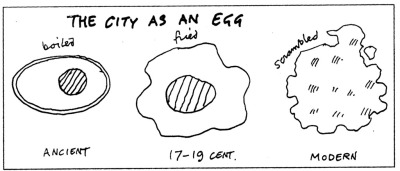
Understanding that buildings cannot present a regular and unified face in this new urban typology, we must see cities as fabrics. As webs of integrated and conversant urban components-- infrastructure, landscape, and shelter-- that is, systems, fields, and objects interwoven to create a coherent and integrated urban 

The urban form has changed over time.
Understand: URBAN itself is a typology for design

GREG LYNN
ANIMATE FORM
Greg Lynn presents the development of visual technology from the perspective that architecture has long been static and is moving toward a state of motion, flow, and arrangement whose mathematical foundations are not cartesian or polygonal, but rather U/V-mesh and spline-based.  This shift, he argues, takes architects from the topology-based model of 'stasis' to a model of 'shifting, shearing, rotation' and movement.  Lynn questions the form of architecture that lasts forever, instead arguing for design that is 'built for obsolescence, dismantling, ruination, recycling, and abandonment through time.' These traits are rarely considered at the outset of an architectural project, but merit consideration, especially from the standpoint of adaptive reuse (considering how spaces and systems will be replaced over time) and the immense strides made in technology (how long will it be before houses have USB connections instead of electrical outlets?).

Regardless, Lynn's main discussion revolves around his argument for a redefinition of space from being neutral and timeless to being temporally dynamic.  He explores how mathematics and 3D modeling programs allow for this process-- for designers can now apply advanced mathematical properties to their digital creations without ever needing to know the geometries and calculus that under-girds their explorations.

Architecture may break from its tradition of stasis
and embrace a position of cultural dynamism

2013-02-23

ARCH 502: Preliminary Manifesto

A preliminary manifesto generated for ARCH 502+522 Urban Design studio.  Taking some cues from Stan Allen, Sanford Kwinter, and the Patron Saint of Architecture. Comments welcome and appreciated!